Saturday, September 8, 2012

Time goes by, so slowly?

We live in a time paradox here in Senegal. Some days I am sitting in my hut, watching the sweat drip down my chest and listening to my clock slowly tick. It is as if the hot, thick, humid air makes my limbs and the second hands of my clock move slower. Tick tock, tick tock.... Is it really only 3 o'clock!
Or on days where all I am doing is sitting and waiting. For a car to leave, for a market trip to start, for lunch to be served.
The other day I had a particularly long wait on a velvet, hard seat in a motionless car from 10 am to 3:30 pm. These 5 and a half hours were just for the car to leave. In the smelly Dakar garage we sat with the window barely cracked open so as to ignore all of the eager fruit and random item sellers from bothering us. Not that it stops them.
Needless to say, I have become very good at doing nothing. You have to here. Patiently waiting for the car that holds 7 people to fill up, myself and 2 fellow volunteers mainly sat and stared, watching all of the well dressed Senegalese calmly get out of taxis and to our despair, load into cars going to Banjul or Kaolack. These fancy people would never venture out to Tambacounda, or other far, inland areas where the heat is more brutal, the electricity more likely to shut off and the roads rougher. So we waited.
The same banana sellers came by for a 5th time with toothless grins and aggressive words, persisting that this time we really needed to buy bananas. Cute little girls in second hand (or rather 'fourth hand') American clothing passed by selling cold water packets- for this I gave in and spent the nickel.

Eventually we left and started the 500 km ride to Tambacounda, sitting in the same seat I had already been sitting in for 5 ½ hours, my tailbone already bruised and my mind already thinking-this day must have 32 hours in it.

But here is where the paradox comes in. I have been here for 6 months already! I am a quarter of a way through and I can not believe it! It seems like it was just a few weeks ago I was eating my last delicious over-sized American sandwich at the airport in Washington DC, nervously chatting with my fellow PCVs. And my first terrifying night in village seems to have been yesterday. But that occurred months ago! And how far I have come since then.
On a daily basis I struggle to stretch my mind back to the morning to remember what I did and realize I have accomplished nothing that day. Yet that is not true. Everything here is done in baby steps and each small step is a gigantic feat.
In six months I have semi- learned a new language and improved upon another. I have read over 20 books. I have made new friends from all over the world, young and old. I have gotten up to doing 60 push ups a day. I have learned about malaria, Islam, skin diseases, Senegalese health care, Senegalese culture and much more. I can now productively help cook several Senegalese meals. I can successfully wash my clothing by hand, taking away the mildew smell. I have even learned how to carry water on head (well I still have to hold on with one hand).

Making this partial list of things I have learned over the past 6 months has made me partially realize the reason for this time paradox. Getting things done here is hard. It takes time to do the smallest thing like traveling 200 miles, and it takes a lifetime or longer to get people to wash their hands after going to the bathroom. That is why days feel so incredibly long while months so short. When looked at individually and on the daily, things take ages to get done making the weeks and the months pass by quicker. A successful day in the US equates to the same amount of work as a successful month in Senegal. 

Now I know this sounds slightly illogical but one thing that I know for sure is that this next year and a half will pass by quicker than I can say, 'Inchallah'.

Monday, August 20, 2012

The Holy Month of Ramadan

Ramadan has been a mixed bag of skittles. (Can you tell I'm hungry?) Some days I appreciate the diligence, devotion and tradition of this holy month. But at the end of the moon cycle, I have to admit, it was pretty frustrating.
For the sake of not having each of you leave with a bad impression of my village's version of Ramadan, I will start with the bad and end with the good.

First, I want to tell you a story. So there is a sweet elderly lady (another Fanta), around the age of 50 but looks 65, who lives 2 huts down from me. She lives with one of Babanding's wives. About two weeks into Ramadan, she got very sick, was coughing, laying down all day and feeling exceptionally weak. She went to the hospital in Dialacoto and came back with some medicine that she was excited to show me. One was an antibiotic of some sort, the other 2 were syrups that seem to merely be for vitamin and iron deficiency.
Now your reaction to this may be similar to what my reaction was- 'Obviously you should NOT be fasting?!!?' But 3 days later, she was feeling better and thus felt inclined to fast.
She continues to take the supplements, but as I explained to her over and over, this is no enough! You shouldn't be fasting! She nods, smiles and politely proclaims 'oh but I am healthy!'
Now you can see how doing 'preventative' health work is going to be difficult/near impossible with this mindset of- 'if I feel healthy at this moment, I cannot doing anything to hurt my body in the long term.'
(Sidenote: This is an advantage of being an outsider who does not speak the language very well. I can say things like 'dont fast!!!', which that may normally offend. But because I am just the 'crazy white lady', they laugh and listen to my advice and Inchallah one person will remember or take it seriously.)

Second story. Naye, Babanding's wife who Fanta lives with, is in her late 20's. She is pretty, kind and energetic. She has 3 children, one of which is a 5 month old adorable baby girl namd Aminata with chubby cheeks and plump legs. Naye goes to the fields at 7 am every morning, carrying Aminata on her back so that she can breastfeed. They return around 2, shower, relax and cook dinner, waiting to break the fast which happens at sunset. 'Mono' or porriage that is sugar water and grounded corn is drunk. Then prayers are said and dinner is eaten around 9:30. She is fasting for Ramadan and has lost at least 15 pounds. Aminata's cheeks are not as chubby as they were 3 weeks ago.
This is Naye
Now this is not always true. I did encounter several pregnant/breastfeeding mothers who were smart enough to not fast. But for those who did fast, I tried, over and over again to explain how their lack of eating means that their baby is also not eating. But like Fanta, they laugh, smile and protest.
Now I dont want to label Naye as a bad mother. She cares a lot for the health of Aminata and even went to Dialacoto during Ramadan for a baby weighing. There, I asked her if Ami was getting smaller. Embarrassed, she quietly said yes.

Now lets not get ahead of ourselves and blame Islam for this. In fact, from personal research, I learned that the religious purpose of Ramadan is to remind people of the poor who do not get to eat and drink water every day. It is supposed to be a month of humbling and thanking Allah. In my opinion, this is a virtuous message, but in this context it has been taken to an extreme and is more of a tradition than the initial purpose as a month of religious understanding. 

This is Tiguida, and that is a tub of peanut butter heaven


I asked everyone why they fast and the only response I received was because it is Ramadan. I constantly pried, trying to get a religious reasoning out of people but was never graced with the answer I wanted to receive. In my village it has become a tradition and a rite of passage. Starting at a young age of 6 or 7, one begins to fast for a few days. Each year they work their way up and provides one with a great sense of pride and maturity. My 16-year old sister, Tiguida, fasted for 18 days. She is typically very shy and down talks her own intelligence and talents. The fact that she fasted for so long was the first time I heard her boast about herself and have a sense of pride in her own abilities. As soon as one marries, one is a 'real woman' and must fast the whole time. 


Ramadan also gives younger children their first opportunity to make meals, pound corn and feed people. I have to include myself in this 'younger children' category as it was the first time I too was allowed to do these things. Where before people would object to me pounding or cutting onions for longer than a few minutes, with the coming of exhaustion and hunger went people's manners. I was finally given the opportunity to prove myself (and given a damn good work out) as I pounded corn or peanuts for 20 minutes without hearing objections.

I 'fasted' for two day. (Still drank water and did not spit out my 'mouth water' like they do) but I did go from sunrise to sunset without eating and by the end of the day I felt a great sense of camaraderie, insight and light headedness. I bonded with my fellow peers as we sat around at 6 pm, dazedly watching food being prepared and longingly staring at the setting sun.

There is one memory of this bonding that sticks out to me the most. After not eating for 11 hours, I was beginning to feel slightly drunk and giddy from exhaustion and hunger. As I was lounging, staring at nothing, I watched one of my sisters trip, slowly stop herself from falling and catch my eye as I was staring, mouth half open. We giggled and without saying any words we knew exactly how each other were feeling. If I tried to function, I would trip too.

The end of Ramadan is a big party. Cows are killed, hair is braided, new flip flops are bought and clothing is made. It is a big party, commemorating the end of a month of fasting, but also a month that mixes up their daily routines. I think on some level most people like Ramadan. It is something to talk about, a reason to switch up one's daily life and an excuse to eat expensive food and once the new moon shines it is over and there have something to complain about for a full 11 months until the suffering begins again. 

P.S. I am sure you have all been quite concerned about if I got to finish all 7 Harry Potter books during Ramadan. Yes, I did (and a few other books) and they were just as amazing as ever. I am now starting the movies to continue the magic. Deb, I wish you and better snacks were with me. ;-) 

Saturday, July 21, 2012

Dancing out malaria


I had a very interesting encounter the other day in my village. First off, let me just say that very few things happen in the day-to-day life here to make any specific day that memorable. For instance, the other day a man in my family got engaged making the woman and children have a little drumming dance party for an hour. We are still talking about it 3 days later.

The other big event that occurred was a doctor's visit to speak about malaria. I was informed about this occasion two days beforehand and was quite intrigued. Upon the day of his arrival I was excited to finally have something on my schedule for the day! At around 4 pm I followed children who were collecting plastic chairs and bringing them to a central area of my village by the road and underneath a massive baobab tree. I found a group of toddlers watching 3 men set up large speakers which they had hooked up to an antiquated music mixing table. Intrigued, I sat down to watch.

I was soon joined by members of my possy who began to do the typical mid-day hair braiding and gossip. After about 45 minutes of this, with no doctor in sight nor musical distraction, I was getting pretty antsy. Eventually the Senegalese popular music that to me sounds like a weird loud electronic noise but to them sounds like an invitation to shake their hips began. As confused as I was by this unexpected dance party, it did work to draw a crowd. Within minutes the crowd grew to about 150 gawkers, hoping to see someone other than a 5 year-old make a fool of themselves dancing. 

(Eventually an American song was played and I successfully embarrassed myself to the entertainment of everyone by singing out loud and shaking around.)

Before delving into details on the “malaria expert's” speech, I will go briefly into something that I have observed in my village and find fascinating- the culture of dance here. First off, as I found in Ghana and lets be honest, this is true with African Americans as well, people here can DANCE! The Jaxanke style consists of hunching over slightly and flapping your arms with a slight bend at the elbow as if one is preparing to take flight. In the meantime, one's feet are stomping to the rhythm of the drum beat (that is usually produced by banging two sticks on a bucket) and one's buttock impressively protrudes upwards. Some days, for the amusement of others I have attempted to reproduce this odd ostrich-like dance that they somehow make look attractive. My performance has resulted in lots of laughs and me looking like I pulled my back muscle and am having arm spasms.

Other than the unexpected style of Senegalese dance, the gender and age dynamics of society really come out with dance. I only once saw a male and female approach each other in the dance arena and it was a husband and wife. EVERYONE talked about how scandalous it was after. At least in the light of day, men and women are completely segregated in the dancing and social area. The men have a circle and the woman have another area, several feet away. These unspoken rules extend to the youth as well making discourse across sexes very mysterious to an outside observer.

So going back to malaria. The doctor from Dialacoto (the bigger town 2km from me) did show up resulting in an immediate scramble to assemble the microphone. After about 15 minutes of the screeching noise that a microphone makes when it is too close to a speaker, people realized the simple truth that when standing farther from the speaker, the horrendous sound does not occur, thus allowing the doctor's discussion to commence.

He started by reading off a paper in French that summarized some basic info about him coming here and malaria season. The fact that he began in French baffles me as it was an immediate trigger for people to not pay attention as 90% of the crowd present does not speak French. The celebrated doctor did switch over to Jaxanke but not quickly enough to stop girls from resume their hair braiding, women to resume their gossip and little boys to resume their wrestling matches. 

After a short 2 minutes, he handed the microphone over to two 16 year-old boys from my family who led the rest of the discussion. While my Jaxanke comprehension is not spectacular, from what I gathered they continued to emphasize the severity of the malaria, reminding the crowd that people die from this illness and to go to the hospital when one feels ill. 

I was impressed with how people took the initiative to generate this discussion on malaria. I had certainly not expected for this sort of domain to be present and was unable to decipher who organized and funded it. My apathy was extended towards the youth who made a dedicated but failed attempt at drawing the crowd's interest by asking questions and occasionally turning the music on for a few seconds. 
Through the gossip and chit-chat they continued to read out of their notebooks, emphasizing the need to protect the pregnant woman and children from malaria. This is a common misconception about malaria, it is a disease that pregnant mothers and children alone need to protect themselves from. So far, I have observed that this misconception is generated due to the fact that pregnant woman alone can receive a free mosquito net free of charge from my health clinic. While this can be viewed as a good program because it ensures that they obtain the net, it also communicates the message that they alone need to sleep underneath the net. My family even goes so far as to put the 5 month old baby under the net during the day in 110 degree weather, with no mosquitoes in sight because of the fear of disease.
 But with that said, I do not think that giving free nets to everyone is the answer as so many NGOs and international organizations have done because this sends the message of, 'oh they are free, I can get one anytime, I will use it to cover my garden because a new one will come next year'. In truth, I have seen more nets on plants then sleeping people. 

Ok so enough of my net rant, going back to the malaria discussion. After another 40 minutes of utter frustration, I too was getting antsy and contemplating leaving when I heard 'Fanta Mamayo!!!' come through the speakers. All I could think was 'oh crap, I am going to have to embarrass myself again in front of all these people by speaking in Jaxanke!' So I nervously made my way up to the microphone. The one benefit to being the white tobab, even if my language sucks, is that everyone did shut up for a second to see what I had to say. While I wished I had reviewed my malaria vocab, I was able to spit out the importance of sleeping under a net and that the mosquitoes with disease come out only at night (something most people here do not know). I reminded people to go to the hospital when ill and come to me with questions! Phewwww!

While none of that was ideal, being able to watch and participate in the half dance, half discussion was a good motivator and learning lesson for me when I try to hold my own causeries. I learned several things: 
First off, the smaller the better and dividing people according to age is key.
Secondly, the simpler, the better. People here to not like to pay attention.
Thirdly, looking official with papers, notes and diagrams gives people the impression that you are really legit and they loveeee that!
Lastly, they do like hearing some music played and see a white person dance!

Saturday, July 14, 2012

In the place of pregnant land

Generally I am not a fan of writing blogs that are long narratives detailing 'this is what I did this day, then I went there the next day, then I ate that for dinner, blah blah blah'. BUT I am going to give into my distaste and recount to you all of the boring details of my time in Kedougou. Primarily because I want to make you all jealous of all the cool things I get to do!!! (Come and visit and we can do these things too!)
First off, Kedougou is the region to the east of Tambacounda (where I am) and boarders Mali to the east and Guinea to the south. From my site, it is 150 km along a decently paved road to the city of Kedougou which feels more like a sprawled village than a regional capital as there is little in terms of larger structures and 'Western' style stores. But due to its reputation as the prettiest region in Senegal, Kedougou has several very nice hotels overlooking the Gambia river to accommodate the tourists who frequent the city.

I realized that there is a major geographical characteristic of Senegal that I have not yet addressed on my blog. Senegal is flat. Like, there are no hills anywhere. When I am biking and I can see the approaching road rise a few meters I think, oh man, here comes a hill! My legs burn just thinking about biking the hills of Berkeley right now. 

Getting back to Kedougou- there are mountains! Well, not really mountains, but there are hills and greenery! Due to the lush, rippling landscape and the Gambia river flowing through, Kedougou is stunning. 

Aside from the beautiful scenery, I enjoyed Kedougou because more people in this region speak Jaxanke (unlike Tamba where very few people in the city respond to my Jaxanke greetings). Because of the geographic location next to Mali and Guinea, both of which are dominated by Manden languages, I was able to use my Jaxanke. Resulting from the lack of acclivity, I had been unable to learn the word for 'hill' until I arrived in Kedougou- 'banko konoma'. A literal translation of this is 'pregnant land', which, if you think about it, is quite logical although I dont know how many pregnant American women would appreciate being equated with mountains.

So now, my bragging will commence. Myself, Anna (my site mate) and Alecia (a fellow Cal grad- we had classes together but never knew each other), left the city of Kedougou for a small village in the hills, 5km from Guinea. After dropping off our backpacks and ordering a chicken dinner that takes 5 hours to prepare as the chicken is SUPER fresh, we decided to brave the storm that was approaching and leave for a hike to the waterfall of Segu. While trekking through a valley the storm hit and became immediately drenched. The 10 minutes of down pour stopped suddenly and the clouds parted in front of us, allowing for our soaked clothes to dry in minutes.
The bush path that began this lovely trek was well marked and easy to follow until it dead ended at a creek.


From there, the 'trail' consisted of hopping over, in and through the creek for over an hour which was an excellent test of my balance and tolerance of nasty slimy things being squished between my toes.


Just when we were thinking that maybe we followed the wrong creek and got lost, we reached the waterfall. We happily waded into the ice cold water and I of course could not give up the opportunity to climb up on a ledge by the fall. Dont worry mom! It was totally safe :) 


The next day we woke up early and walked to a near by village, Dindenfello, and hike to the waterfall there. I had been informed that the waterfall of Dindenfello was much more magnificent and I must admit, it is.


The falls of Dindenfello rises over 150 meters into the sky and cascades down the rock wall into a refreshing pool of water that I could not give up the opportunity to swim in. When I thought it could not be any more beautiful, I realized that when standing to the left of the fall, one could see a rainbow that circled around and through the fall. The only thing that could have made it better was if I also found a pot of gold.

As it is the start of the rainy season, the falls had a decent flow but I was informed that in a month time they become even more beautiful.


The remainder of my time in Kedougou was split up between visiting the sites of 3 fellow volunteers. I started in Chip's village, a short 8km bike ride out of Kedougou city where the infamous Senegalese hospitality was validated to me. We decided to stay an extra day because his family INSISTED on make me a special lunch with goat meat.


I was happy take the extra time not only because of the chance to eat meat, but because we got to take the trek to the river where women, young and old, go to wash things from clothing, to pots, to floor mats. Like the good Senegalese woman I am, I carried laundry on my head, which always gets the crowd giggling.

The cultural by the river is fascinating. This day was especially crowded due to the rain that was forecast for later on.

The shore is segregated via age group, the older the woman the better rock to stand by, which they then use as a washing board and whacking place for dirty clothing. My favorite part of the river is the fishing. Young girls tie fishing line with hooks to the end of sticks and wade into the river until they the water rises to their stomach. Pounded corn that is formed into a ball shape is used as fish bait, which works surprisingly well! Within a minute a small fish about the size of your palm is caught, smacked on the surface of the river to kill, and saved in a bowl to fry up for later. Boney and not too tastey but better than nothing!

 After Chip's village, we biked the 20 km of hills to Chrissy's village where we were honored with 2 dinners. The next morning we biked to Saraya where our language seminar was held in the home of Annie and Patrick, the sweet married couple from our PC stage group. Six of us spent the next 3 days with a Jaxanke/Malinke language teacher, asking questions about phrases that I have heard for the past month but could never quite figure out. 

After an action packed two weeks I was happy to return to Tamba to do a little 'interneting' until I depart for my village later today. I anxiously await some privacy and relaxation time that I get there, although I anticipate that I will try out my green thumb in the next few days and go to the peanut fields. I'll let you know how I do!

Monday, July 2, 2012

Ataya


There is an infinite number of themes, stories, random rants and topics that I want to focus on but I have decided to write about something that is vital to Senegalese culture, and I find extremely frustrating- tea.

First off, I need to explain that there is a series of very specific and complex steps that one follows in order to make Senegalese ataya tea. It is not the easy tea bag you throw into hot water. 

Step one, the children fetch the hot charcoal to place on the mini stove where the pot of water sits upon  until a boil. The tea here comes in small cardboard boxes with one bag of open leaves that is all used up per-brew. It is purchased for 100 cfa or 20 cents. At a boil, 3/4ths of the leaves are poured in and then sit for over 20 minutes. After a sufficient amount of time the bag of sugar, about 1 cup full that is purchased for the same price as the tea, is then slowly poured upon the liquid leaf substance. For the first round, 1/4th of the bag is poured in. Then the brewer pours part of the hot substance into shot sized glasses and alternates pouring the tea from one glass to another, making a foam at the top of the glass. This is done for aesthetics, to mix the tea, and in my opinion, to prolong the process.

After more sugar adding and more tea mixing, the tea is served. First to be drunk by the most respected person present, usually an elderly male who purchased the tea, then elderly females and down from there. In my village, they fill the cups up half way to stretch the amount out and share the precious golden liquid amongst 8 or so people. After the first round is gone, the process is repeated using the old leaves and the other ½ cup of sugar.

During training I found it be frustrating mainly because it was such a 'male only' act. The men would use it as an excuse to sit around and do nothing for 2 hours during the middle of the day. It was not acceptable for woman to make it and the youngest boy was called upon to brew this shot glass of hot, sugary deliciousness. 

While the gender aspect and the infiltration of laziness from the tea making culture I still find frustrating, the finanial aspect of ataya currently frustrates me more. (The other day I was biking home and found my father at the side of the road, sitting next to his field brewing tea with 4 other men. This was their 'day at the fields')

200 cfa, or 40 cents USD may not seem like a lot of money but it can go very far here. For instance, when I go fukijay shopping (buy used clothing that has been shipped in from the US, you would be amazed at the cute stuff I find!), a skirt, shirt or dress is all 100cfa! Also a large mango, baguette with beans and onion sauce (yumm), small bag of onions, half a kilo of bananas, are all 200 cfa. So while, it is not like this could buy an entire meal, it is a considerable amount of money, and people constantly ask me to buy them these things, but especially tea. There is one woman who I cannot pass during the day without her asking me if I bought and drank tea yet today. When Anna visits, its ohhh buy tea for her, when I am reading it is ohhh buy tea and when I am cracking peanuts its ohhh tea would go well with this. AHHHH!!!!!!!!!!

My large Tanjan family is not wealthy nor extremely impoverished but they could use the extra 200 cfa. There is rarely meat or veggies in our meals, they fight over small packets of spices that cost 25cfa and they jealously gawk when I eat a mango. But still, they drink tea on the daily. 
From my perspective, Ataya tea is a superfluous expense, money that could quite easily be used on things that they ask me to buy for them- like medicine or healthy food options- but they choose this sweet golden liquid over curing an infection.

So due to my title as a health volunteer I am using ataya as my first 'health' project. With every shot, one is ingesting several tablespoons of sugar, which we know to not be great for you. Now whenever I am offered tea, I explain that sugar is not healthy for one's body and that fruit is a better sugar option (dont tell anyone I just ate 2 handfuls of Skittles in my hut). Due to this health aspect and the fact that financially, this money could go so far elsewhere, I have taken a pledge that is occasionally difficult to stand by. I will not buy tea nor will I drink tea for the remainder of my stay in Senegal. I will inform you as to how long my rebellion lasts.


Leaving for Kedagou- 4th of July celebration with 200 other PCVs, followed by visits to waterfalls and a meeting with my Jaxanke teacher for intensive language learning- it will be a fun 2 weeks! Ill try my best to keep you all informed!

Saturday, June 23, 2012

Daily Routine


My village is in an ideal location (or at least I think so). I am 1km off of a major, well paved road that has a large 'road town' called Dialacoto 2 km from my village. In Dialacoto I can charge my phone, buy a cold coke, eggs, bread and (heaven forbid) go to a hospital if need be.While internet is not accessible, it is nice to have a place with these luxuries and it provides me with a larger community to work with if I felt so inclined.
Almost everyone in my village is a peanut farmer but interestingly most have some sort of supplementary income coming in from family members working in the US, Spain or France.The rainy season is currently beginning (so it should cool down! yah!). This means that everyone is going to the peanut fields during the day and burning the ground to prepare for planting.
My name here is Fanta Mamayo Tanjan. The Tanjans are 50% of my 700 person village. Essentially my family dominates the village in terms of size and power. The chief (my dad) and the Imham (the muslim leader) are both Tanjans. The hard part of this is that I don't have an enclosed compound per-se but live in an area of the Tanjan Kunda. Therefore, whenever I go anywhere, I pass by 70+ people who are members of my family and who get offended if I dont greet them, tell them what I am doing, where I am going and why. As you can imagine this gets annoying but on the bright side, for now, it is great language practice!
Group of women who were overly eager to get their pic taken inside of a hut. Half these women I really like, the other half I really dont.


The village chief, my father, is over 70 (aka ancient and looks like he will die any minute) is half crazy, cant hear, chain smokes cigs and eats kola nuts like candy. I live directly next to his son, Babanding, who is the acting chief. He has 3 wonderful wives who look after me and are more of my 'mothers' in village. The first wife is the woman who I have been instructed to give my food contribution to and who is kind of expected to make sure I am fed and doing well. Her and the 3rd wife do NOT get along, so much so that one night while I was in village they had a screaming, fighting match that continued for over 3 hours. Other than that I have never seen them acknowledge each other.
The rest of my village is very friendly and understanding. I can walk into any compound and feel welcomed to sit down and show off my peanut cracking skills or my pounding skills. While they dont really understand why I am living there for two years, everyone is happy to have a weird 'toubab' sit and chat with them. 

Naye is Babanding's second wife. Aminata is the baby and Naye's youngest daughter.
I also want to emphasize the fact that every village here is so extremely different. The dialectics of Jaxanke vary in my village and the road town 2 km from me. Additionally, Anna's village speaks an entirely different language and her family experience, food and living situation is completely opposite to mine. The family that I stayed with during training is so different from my current family that it seems they are from another country. From fashion to gender roles to employment opportunities to cultural faux-pas, every village and every compound is unique.

 In order to give you a better picture of my day to day life in village, here is a pretty accurate schedule of what every day is like for me in village, especially for these first few months here when I am really not doing too much. 

06:00- I am awake at 6 every morning (quite the opposite of my college life schedule) and I go for a run. Any later than this and the heat would be so unbearable there is no way I could run.
07:30- After getting water from the well, taking a bucket shower (these are surprisingly enjoyable) and watering my plants, I make a nice hot cup of Nescafe and a big bowl of oatmeal (accompanied with several spoons of peanut butter). I enjoy my 'American breakfast' in my hut and read for about an hour before I venture outside
09:00- Walk around the 'Tanjan kunda', greeting my family members and asking how everyone slept and their plans for the day. Depending on who is doing what (aka if they are people I like or not), I will sit and help cook or crack peanuts for 30 minutes.
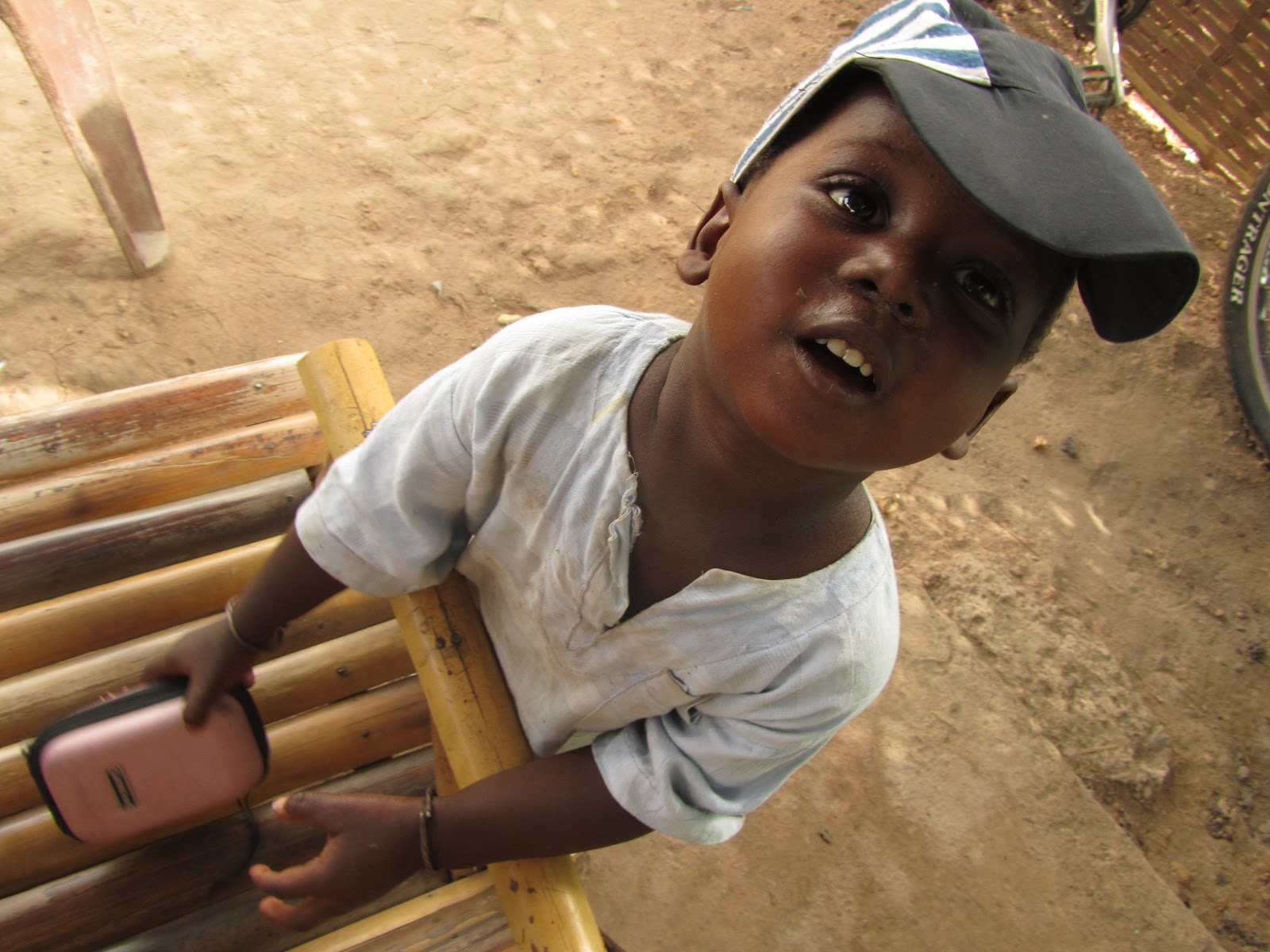
This is my fav little boy, Lamini. On the last day in village he accompanied me for my morning greeting around the village. It was adorable.


10:30- Go to other homes in the village, venturing out into random compounds to meet other people in the community and practice my language
12:00- Return to my hut for a snack and reading time. Yah, I get to read a lot.
14:00- Go out onto my stick bed in the front of my hut to read, play with kids and wait until lunch
15:00- Am called for lunch which I eat with 8 other women. By this time yes I am starving and praying that there is extra peanut sauce on my plain rice
15:30- Head back to my hut to take a 'nap' aka eat another mango and read for another hour
16:30- Make my way back out to my family area to see who is cooking dinner and where. If one of my two sisters who are of age to be in charge of a meal are cooking dinner then I will help them. If not I usually help some of the older women with cracking peanuts. I find that I like women between the ages of 0-22 or 50+ but the women in between are unsympathetic, uninterested and I find some to be jealous of my freedom and lack of responsibilities.
18:30- Go back to my hut area and take another shower.
19:00- Hang out with some of the school age girls and help them with their homework. Or I teach kids how to do a puzzle, play Connect 4, or bring out the crayons and play with the young ones.
20:30/21:00- Eat dinner with my group of women. Afterwards I sit under the stars and listen to the women gossip for a bite before heading off to my hut to read for a few minutes.
22:00- Sweating but sound asleep!

The main exception to this schedule is Wednesdays where I make my way to Wassadou, buy fruits and veggies at the big market there and then make my way to the river where Anna (the new volunteer in Wassadou) and I sit and eat bean sandwiches and enjoy not having to tell someone what I am doing every other minute. I have also been able to take some trips to neighboring villages and festivals with my family making some days more interesting than others but as of now, I love my relaxed, reading and chatting schedule. Hell, this is not a bad 'job'!

Friday, June 22, 2012

5 weeks of 'checks'


My girls.
 So much (and yet so little) has happened in the past 5 weeks, my first 5 weeks in my village, that it is impossible to summarize. As everyone continuously warned me, I had my ups and downs. In a matter of minutes I could feel totally great, be thinking that my language had improved enormously, I was connecting with people and being here for 2 years would be no problem. Then one person makes a comment about buying them tea or medicine or a makes a snide remark about my language and I could be ready to burst into tears. But with that said, I had a great time, learned so much and was able to do more reading, sketching and sleeping than I have ever been able to do before! I can get used to this!

In order to give you all a quick, overall picture of somethings that I have done, here is a 'checklist'
  • Woken up with a pillow so damp from sweat that as soon as I walk away it is swarmed with fruit flies and takes 6 hours to try off -Check!
  • Mastered the art of cracking peanuts -Check! (everyone in my village are peanut farmers so any downtime consists of women sitting around with massive buckets of shelled peanuts that they 'de-shell'. Good for me because it keeps my hands busy and they see that I am doing some 'work')
  • Biked 5 km back to village through a sand, wind, rain storm -Check!
  • Read 8 books -Check!
  • Gotten 5 flat tires. -sadly, Check!
  • Was stung by a bee for the first time ever! -Check!
  • Puked mango in front of a group of school kids while riding a bike -Check! (note to self, NEVER take doxy after only eating a mango for breakfast, dont worry I was fine! Maybe tmi?)
  • Eaten an entire bag of TJs nut mix in less than 2 days -Check, check! (ya, protein is hard to get)
  • Finished off a duffel bag of snacks -7/8ths Check! (thank goodness I got 2 more packages of snacks to tide me over! Thanks Kate!! :)
  • Danced in front of over 100 people -Check!
  • Danced with an 80 year old woman when no teeth, no top on and boobs swinging down to her belly button -Check!! (damn I wish I had a pic of that!)
  •  Eaten endless, endlessssss amounts of rice -Check...
  • Yes, that is all rice in that massive kettle behind the women.... 


  • Mastered this conversation in Jaxanke:  
Me: No I dont have a man,yes I am old but no I dont want to take you for a husband.  
Senegalese man/woman who wants me to marry their son: Why?
Me: Well will you cook and clean for me?  
Senegalese: Oh... well than, what will the children do if the parents do all of the work?!?
Me: Ummm, learn!
 -Check!
  • Walked 7km to and from a neighboring village with 11 other women -Check!
  • Sat at the Wassadou Campament for hours watching: hippos, birds, baboons and lizards -Check!
  • Showed kids puzzles! -Check!
  • Mastered pounding corn -1/4th Check, I try.... 


  • Gotten a group of 2 year old boys to fall in love with me -Check!!! 
    • Love them back and tell their moms I will take them back to America with me -Check!
  • Survived my first crazy rain, wind, sand, flash flood storm in my hut -Check!
  • Found the perfect reading tree 3km from my village -Check! (it is large and secluded with good roots to sit on. I am sure I will spend hours there in the next two years!) 
 
Come visit me! This is where we will hang out! :)