Saturday, December 22, 2012

Happy Holidays!!

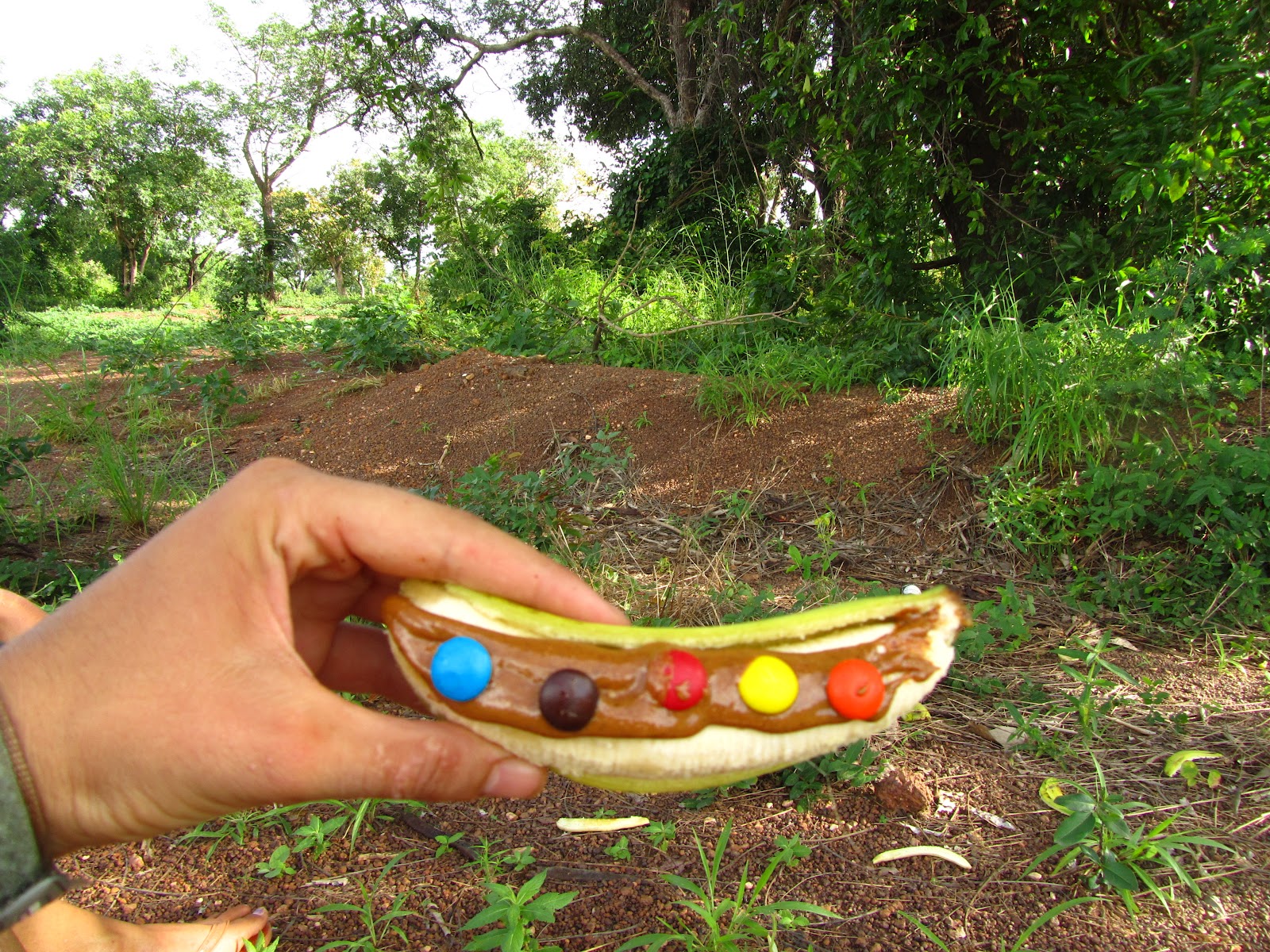
Made latkuhs in village, they were DELICIOUS and so easy! Will have to make them again, does not have to be during Hannukah!
 Missing all of you during the holiday season! Cant believe I have been gone for 9 months! Now that I have been here so long, I have become quite accoustomed to life and forget that there are so many things that have become normal to me, that would seem so bizarre and interesting to you! For instance- school, food, health, funerals, births, work, not work.... the list goes on and on. But alas, those blogs will have to wait til next time!

But here are some pictures I took during my last village stay to make up for my writing laziness. Happy Holidays, eat lots for me and hugs to all!

Gave some to Anna's family. They loved them!!

Nice pile of peanut plants.

My pregnant mother 'tiga suru suring'. Essentially wait for wind and pour the peanuts out while the leaves separate, blowing away.

Post lunch wrestling tournament. I joined in as well. Dont worry, i won.

Thursday, November 29, 2012

Peanuts here, peanuts there, peanuts EVERYWHERE!

Did you all know it is peanut harvesting season in Senegal?!?! Very exciting for me because it involves a new variety of snacks. My favorite is fresh , roasted peanuts. So fresh I first pull up the plant out of the ground, carry it home and give it to my sister who then gets some hot coals ready while I individually pull the peanuts off of the plant. Ever had peanuts that fresh? Delicious.

It is almost worth going to the fields for this perfect snack. Peanut farming is tough work!!!! The actual process pre-harvesting is long and extensive so I will save you from hearing about that until another time. But, if you are interested, here is what it takes once the plants are ready for harvesting. 

First, the woman have to  hire men (4 dollars a day) to 'tiga jaxuu' or go around with a hoe and dig around the plants, pulling up the roots. I tried to dig up one plant and was sweating sooo much, took me about 5 minutes while my mom does it in 30 seconds. But still, this is man's work so the woman have to hire men to do most of it.

I had 2 wonderful American university students from Dakar visit me and while they were here we helped with the next step of peanut farming- 'tiga nekelo' or the gathering of the plants into large piles. For them, it was an eye opening experience and were very impressed as I did all of the work, WHILE carrying a baby on my back. (I was impressed with myself as well.)

The next step is 'tiga tiumbo' where you comb through the dirt to pick up individual peanuts that had fallen off of the plant and are a individually hiding in the dirt. After 2 hours of this my neck was killing me from leaning over and preforming this tedious task. Following this, the smaller peanut plant piles are collected and placed into larger peanut plant piles. Then people hit the piles with sticks, making most of the shells fall off.

I am not totally sure what happens after this step... but I am guessing that is the point when the majority of the peanuts get brought back to the village on a donkey drawn cart. Once in village women wash the shells with water (tiga kuu), crack open the shells (tiga woto), toss the peanuts to separate the shell and the peanut (tigo tofe), sort through the peanuts for the bad vs. good ones, and FINALLY go to the market to sell them.

Sound exhausting? Think about that next time you snack on some peanuts while watching TV or eat a PB sandwich (oh dont even get me started on how many more steps it takes to make PB). But I must say, I am very glad I am in a peanut producing culture because at least I get some protein from them and can never be sick of eating too many peanutst!!

Sunday, November 4, 2012

Tabaski is to Muslims as Christmas is to Christians


Sheep lots are to Tabaski as Christmas tree lots are to Christmas

Tabaski (or Eid al-Adha) is one of the most important Islamic holidays when Muslims celebrate Abraham's willingness to sacrifice his son, Ishmael. Instead, Abraham slaughtered a sheep as a sacrifice to god. To commemorate this event, Senegalese kill sheep and eat the meat for the following few days.
A week prior to Tabaski I took a short trip to Thies and Dakar, not realizing the impact that Tabaski preparation has on Senegalese economy and daily routine. Fields on the side of the road that are typically empty were instead filled with Pulaar men and their herd of 20 or more sheep. Each man proudly stands next to their crop that they have tied together with a rope, making the sheep form a large, noisy circle. We passed by over ten of these 'lots', each with more sheep circles than the one before. Depending on the size, a sheep can go from 30 USD to over 300 USD. The bigger the sheep you buy, like bigger the tree, the more impressive and successful you appear to be.
I was taking a 'mini bus' back to my village, when we stopped to load on one of the passenger's cargo. And lo and behold, it was about 25 sheep that were loaded onto the top of the car and stuffed underneath our feet. At one point, to the chagrin of the owner, one of the badly tied sheep fell off the top. He survived. As I descended the car, I realized that I was covered in sheep hair. Lovely.

Chopping down Christmas trees are to Christmas as slaughtering sheep is to Tabaski

The morning of Tabaski I awoke to the sound of a beating drum, summoning the call to prayer. I dressed quickly as I did not want to miss any of the exciting events. I soon discovered that the only real thrilling thing that happens on Tabaski (like many big holidays) is cooking and eating. After helping cut onions for over an hour, I saw the men sharpening knives and knew what it meant. The killing had commenced!
In less than 10 minutes there were 7 dead sheep with their necks sliced open and blood splattering the dirt. The boys and men worked together to saw away at the sheep, placing meat pieces on random scraps of metal. The meat was the distributed to the woman to cook different parts in different shifts throughout the day. (oh and of course all this meat just sits out for the next two days with flies and other insects crawling on it. Everyone touches the raw meat and then eats without washing their hands. Needless to say my stomach was not very happy for the following few days.) I saw more meat consumed on this day than I have the entire time I have been in my village combined. 
The important female elders feasting over a massive bowl of meat

Going to the market is to Tabaski as going to the mall is to Black Friday

The other major aspect of Tabaski is getting new clothing. The only time for the entire year that most people get new clothing is for Tabaski. Most children received two new outfits, a pair of new shoes and new jewelery. In addition, all the girls had their hair done in fancy up-does, with yarn or hair extensions that go down their backs. Even a week prior to Tabaski, going to the market is insane, everyone is fighting over articles of clothing, bargaining for jewelery and trying to find the correct size of shoes. I was not brave enough to fight through the crowds and decided to buy bananas outside of the zoo rather than venture in.
My 6 year-old sister was so excited to put on her new outfit that before she even showered on Tabaski morning she demanded to put on her skirt-shirt combo. Sadly, the top was too small to fit over her head and after 5 of us tried to pull it over her, we gave up and the outfit was put on the 8 month old baby. So cute.


Baby Ami is wearing the oversized/undersized outfit, held by Naye.


The climax is to Tabaski as the climax is NOT to New Years

Bintu all dressed up, ready to go!
Unlike the kids, I was less excited to put on my outfit that I had gotten sewn for my Swearing in Ceremony. As pretty as it is, it is so hot and uncomfortable so I kept pushing it off until my mother wore her new outfit. 
After lunch she said she would not put it on until the next day when all the woman go to greet other families and surrounding villages. I too decided to put it off until morning. 
So the next day, I bravely put on my complet and prepared myself for an exhausting day of greetings. After gathering together with over 40 woman, all dressed in their new, fancy outfits, showing off their embroidery and new necklaces, we set out. On the short walk to Dialacotto I got many shouts from impressed villagers and had several head scarves thrown at my feet. (This means that my outfit was fancy and I was supposed to throw money onto it.) 
We arrived at a compound I had never been before and all 40 of us stuffed ourselves into their little room where an elderly, possibly blind woman, was sitting. After several rounds of greetings and prayers for the coming year we got up and left. I thought to myself, well that is not bad, went by fairly quickly. How many more people will we greet? I soon learned that that was it. We were headed back home. I could not believe it! We all got dressed up for that! All of you have been preparing for months for that! To greet one lady and then go home! 
I took off my already sweaty complet after having worn it for less than two hours. What an odd, uneventful event.

Saturday, November 3, 2012


Thanks to all of the amazing people who have sent me goodies, food, love, and letters! This is the corner of my room where I put up all of my letters! I look at them everyday and think of all of you! Thank you!

 I am sorry that it has been so long since my last post! Once again, time just goes by and before I know it- its November!! Since my last post many, (but really very few) things have happened. The most exciting of which is that two monitor lizards dug a hole through the outside of my latrine and into the pit and were living there. Google monitor lizards. They are disgusting. Too much info? Sorry.
My health hut has been functioning successfully and I hang out there most days. My baby sister no longer cries when she looks at my white skin so I now carry her everywhere on my back. I joke that I will also carry her to the States although who knows if its a joke.... ;)
 The corn is ready which allowed us to have delicious snacks of burned corn for a few weeks. Okra is also in season and I spend many hours carefully slicing buckets okra into tiny pieces with one of my mothers. It is then dried, pounded, sifted and cooked with peanut water. Cooking here has a few more steps than in the states...
Halloween passed by for all of you, and i had an even more important holiday that involved  killing many sheep....

Tuesday, October 2, 2012

Are we in the middle of no where yet?


I am sure that my mom has annoying memories of this, but when I was young on road trips my reoccurring question was always- are we in the middle of no where yet? We would drive through the Central Valley in California and I would ask my favorite question, disappointed that within a minute of asking I would see another freeway exit and fast food restaurant. I never reached what I imagined to be 'the middle of no where'. Well I am pleased to report, years later, I finally feel satisfied. I have found my 'middle of nowhere'.

For my Birthday celebration I took a trip down to the Kedougou region, 150 km down the road from my site. After being treated to an amazing, delicious meal at a 'fancy' restaurant, making brownies and spring rolls, and watching '30 Rock', I felt like my American needs were fulfilled and could make my way to my Chrissie's village for my birthday. A gentlemen from her village was kind enough to give us a ride in his ancient truck, so during a rain storm we loaded into the car, only vaguely finding shelter from the storm.  


Once we arrived at Chrissie's home, I found that her family filled their roll as welcoming Senegalese hosts. A chicken was purchased for dinner. While it was not exactly well cooked, I was pleased to finally eat my favorite meat in a village. After playing with children and being proposed to by several women to marry their husbands with them, we played cards and went to sleep early, preparing for our bike ride the next day.


We embarked on our bike ride around 7 am, not realizing how long of a day ahead of us we had. In the beginning there were a few road blocks, literal and figurative. Starting with a dog that would not get out of my way so I accidentally hit it. Ops... I promise it was fine! Next there was a group of protesters, blocking the entire road and refusing to let us through. We slipped through the village, carrying our bikes through compounds and over fallen trees. A typical day.


We reached the town of Saraya where we stopped for breakfast, and discovered that our ride was 40 km longer than we thought. Ready to bike over mountains with a bag of peanut butter, bananas and bread, we left during the heat of day. And man was it hot!! Kedougou is beautiful, green, mountainous, and humid! We slowly passed through small villages where woman stood in pools of water, panning through the murky fluids in search of gold. This is the region where gold was recently discovered, making the culture and economy change dramatically in a short period of time. Evidence of significant wealth is omnipresent but is always paired with the extreme poverty, those who are actually searching for the golden flakes. 

Getting up from a lovely lunch break, I realized that the marker for the next village was not for another 20 km. We continued into the unknown, sweating through a hill that was at a continuous incline for 3km. When I finally saw that a downhill slope was near I gathered the energy to look up from the blacktop, and felt a wave of satisfaction- this is the middle of no where.
For miles upon miles surrounding us, all I could see were the tops of green rolling hills, clumps of tall trees paired with overgrown grass and the faint outline of the black road we were following. No village, car, person, donkey or sheep was in sight. This is the epitome of the middle of nowhere. 


The final 10 km were painful. The kilometer markers seemed further and further away, and when we finally pulled into our destination city all I could think about was a good shower and clean bed. We spent the next day wishing we had the energy to explore the city's surroundings. Sadly, due to my coughing fits and Chrissie's sore legs all we could do was stare at the lovely backdrop, play Rummy 500 and remember yesterday's accomplishments.

Saturday, September 8, 2012

Time goes by, so slowly?

We live in a time paradox here in Senegal. Some days I am sitting in my hut, watching the sweat drip down my chest and listening to my clock slowly tick. It is as if the hot, thick, humid air makes my limbs and the second hands of my clock move slower. Tick tock, tick tock.... Is it really only 3 o'clock!
Or on days where all I am doing is sitting and waiting. For a car to leave, for a market trip to start, for lunch to be served.
The other day I had a particularly long wait on a velvet, hard seat in a motionless car from 10 am to 3:30 pm. These 5 and a half hours were just for the car to leave. In the smelly Dakar garage we sat with the window barely cracked open so as to ignore all of the eager fruit and random item sellers from bothering us. Not that it stops them.
Needless to say, I have become very good at doing nothing. You have to here. Patiently waiting for the car that holds 7 people to fill up, myself and 2 fellow volunteers mainly sat and stared, watching all of the well dressed Senegalese calmly get out of taxis and to our despair, load into cars going to Banjul or Kaolack. These fancy people would never venture out to Tambacounda, or other far, inland areas where the heat is more brutal, the electricity more likely to shut off and the roads rougher. So we waited.
The same banana sellers came by for a 5th time with toothless grins and aggressive words, persisting that this time we really needed to buy bananas. Cute little girls in second hand (or rather 'fourth hand') American clothing passed by selling cold water packets- for this I gave in and spent the nickel.

Eventually we left and started the 500 km ride to Tambacounda, sitting in the same seat I had already been sitting in for 5 ½ hours, my tailbone already bruised and my mind already thinking-this day must have 32 hours in it.

But here is where the paradox comes in. I have been here for 6 months already! I am a quarter of a way through and I can not believe it! It seems like it was just a few weeks ago I was eating my last delicious over-sized American sandwich at the airport in Washington DC, nervously chatting with my fellow PCVs. And my first terrifying night in village seems to have been yesterday. But that occurred months ago! And how far I have come since then.
On a daily basis I struggle to stretch my mind back to the morning to remember what I did and realize I have accomplished nothing that day. Yet that is not true. Everything here is done in baby steps and each small step is a gigantic feat.
In six months I have semi- learned a new language and improved upon another. I have read over 20 books. I have made new friends from all over the world, young and old. I have gotten up to doing 60 push ups a day. I have learned about malaria, Islam, skin diseases, Senegalese health care, Senegalese culture and much more. I can now productively help cook several Senegalese meals. I can successfully wash my clothing by hand, taking away the mildew smell. I have even learned how to carry water on head (well I still have to hold on with one hand).

Making this partial list of things I have learned over the past 6 months has made me partially realize the reason for this time paradox. Getting things done here is hard. It takes time to do the smallest thing like traveling 200 miles, and it takes a lifetime or longer to get people to wash their hands after going to the bathroom. That is why days feel so incredibly long while months so short. When looked at individually and on the daily, things take ages to get done making the weeks and the months pass by quicker. A successful day in the US equates to the same amount of work as a successful month in Senegal. 

Now I know this sounds slightly illogical but one thing that I know for sure is that this next year and a half will pass by quicker than I can say, 'Inchallah'.

Monday, August 20, 2012

The Holy Month of Ramadan

Ramadan has been a mixed bag of skittles. (Can you tell I'm hungry?) Some days I appreciate the diligence, devotion and tradition of this holy month. But at the end of the moon cycle, I have to admit, it was pretty frustrating.
For the sake of not having each of you leave with a bad impression of my village's version of Ramadan, I will start with the bad and end with the good.

First, I want to tell you a story. So there is a sweet elderly lady (another Fanta), around the age of 50 but looks 65, who lives 2 huts down from me. She lives with one of Babanding's wives. About two weeks into Ramadan, she got very sick, was coughing, laying down all day and feeling exceptionally weak. She went to the hospital in Dialacoto and came back with some medicine that she was excited to show me. One was an antibiotic of some sort, the other 2 were syrups that seem to merely be for vitamin and iron deficiency.
Now your reaction to this may be similar to what my reaction was- 'Obviously you should NOT be fasting?!!?' But 3 days later, she was feeling better and thus felt inclined to fast.
She continues to take the supplements, but as I explained to her over and over, this is no enough! You shouldn't be fasting! She nods, smiles and politely proclaims 'oh but I am healthy!'
Now you can see how doing 'preventative' health work is going to be difficult/near impossible with this mindset of- 'if I feel healthy at this moment, I cannot doing anything to hurt my body in the long term.'
(Sidenote: This is an advantage of being an outsider who does not speak the language very well. I can say things like 'dont fast!!!', which that may normally offend. But because I am just the 'crazy white lady', they laugh and listen to my advice and Inchallah one person will remember or take it seriously.)

Second story. Naye, Babanding's wife who Fanta lives with, is in her late 20's. She is pretty, kind and energetic. She has 3 children, one of which is a 5 month old adorable baby girl namd Aminata with chubby cheeks and plump legs. Naye goes to the fields at 7 am every morning, carrying Aminata on her back so that she can breastfeed. They return around 2, shower, relax and cook dinner, waiting to break the fast which happens at sunset. 'Mono' or porriage that is sugar water and grounded corn is drunk. Then prayers are said and dinner is eaten around 9:30. She is fasting for Ramadan and has lost at least 15 pounds. Aminata's cheeks are not as chubby as they were 3 weeks ago.
This is Naye
Now this is not always true. I did encounter several pregnant/breastfeeding mothers who were smart enough to not fast. But for those who did fast, I tried, over and over again to explain how their lack of eating means that their baby is also not eating. But like Fanta, they laugh, smile and protest.
Now I dont want to label Naye as a bad mother. She cares a lot for the health of Aminata and even went to Dialacoto during Ramadan for a baby weighing. There, I asked her if Ami was getting smaller. Embarrassed, she quietly said yes.

Now lets not get ahead of ourselves and blame Islam for this. In fact, from personal research, I learned that the religious purpose of Ramadan is to remind people of the poor who do not get to eat and drink water every day. It is supposed to be a month of humbling and thanking Allah. In my opinion, this is a virtuous message, but in this context it has been taken to an extreme and is more of a tradition than the initial purpose as a month of religious understanding. 

This is Tiguida, and that is a tub of peanut butter heaven


I asked everyone why they fast and the only response I received was because it is Ramadan. I constantly pried, trying to get a religious reasoning out of people but was never graced with the answer I wanted to receive. In my village it has become a tradition and a rite of passage. Starting at a young age of 6 or 7, one begins to fast for a few days. Each year they work their way up and provides one with a great sense of pride and maturity. My 16-year old sister, Tiguida, fasted for 18 days. She is typically very shy and down talks her own intelligence and talents. The fact that she fasted for so long was the first time I heard her boast about herself and have a sense of pride in her own abilities. As soon as one marries, one is a 'real woman' and must fast the whole time. 


Ramadan also gives younger children their first opportunity to make meals, pound corn and feed people. I have to include myself in this 'younger children' category as it was the first time I too was allowed to do these things. Where before people would object to me pounding or cutting onions for longer than a few minutes, with the coming of exhaustion and hunger went people's manners. I was finally given the opportunity to prove myself (and given a damn good work out) as I pounded corn or peanuts for 20 minutes without hearing objections.

I 'fasted' for two day. (Still drank water and did not spit out my 'mouth water' like they do) but I did go from sunrise to sunset without eating and by the end of the day I felt a great sense of camaraderie, insight and light headedness. I bonded with my fellow peers as we sat around at 6 pm, dazedly watching food being prepared and longingly staring at the setting sun.

There is one memory of this bonding that sticks out to me the most. After not eating for 11 hours, I was beginning to feel slightly drunk and giddy from exhaustion and hunger. As I was lounging, staring at nothing, I watched one of my sisters trip, slowly stop herself from falling and catch my eye as I was staring, mouth half open. We giggled and without saying any words we knew exactly how each other were feeling. If I tried to function, I would trip too.

The end of Ramadan is a big party. Cows are killed, hair is braided, new flip flops are bought and clothing is made. It is a big party, commemorating the end of a month of fasting, but also a month that mixes up their daily routines. I think on some level most people like Ramadan. It is something to talk about, a reason to switch up one's daily life and an excuse to eat expensive food and once the new moon shines it is over and there have something to complain about for a full 11 months until the suffering begins again. 

P.S. I am sure you have all been quite concerned about if I got to finish all 7 Harry Potter books during Ramadan. Yes, I did (and a few other books) and they were just as amazing as ever. I am now starting the movies to continue the magic. Deb, I wish you and better snacks were with me. ;-)